
Museo e Parco archeologico nazionale di Capo Colonna
Type:
Luoghi della cultura; Ente/Istituzione
Category:
Archaeology museums
Among the main archaeological sites of Calabria, the site of Cape Colonna is always tied to the history of Crotone. During Greek and Roman times it was called Cape Lacinio and there was a large Sanctuary dedicated to the goddess Hera.
The veneration given to Hera Lacinia brought devotees of various origin to her temple, with rich votive gifts. The Sanctuary, remembered also for being frequented by the great philosopher Pythagoras, earned such great fame to become probably the seat of the Italiota League, a confederation in political and military terms which brought together all the Greeks of the West. From here the great enemy of the Romans, the military leader Hannibal, departed to return to Carthage.
The Sanctuary, precisely because of its location on a promontory, also represented an essencial point of reference for navigation and a safe haven, of which the goddess was the guarantor. But Hera also protected nature, and in particular the cattle grazing freely inside her sacred grove.
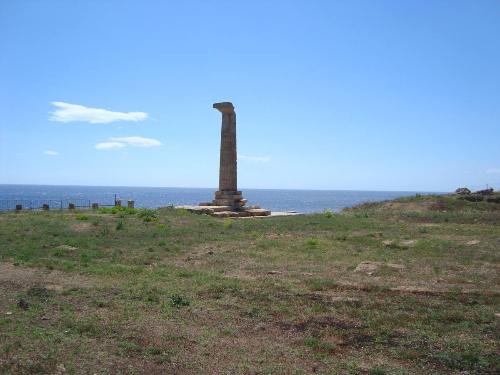
Today the site is known and visited especially for the lone surviving column of the great temple dedicated to the goddess.
Of the Doric temple (temple A) erected around 470 B.C. there remain the enormous trenches dug for the foundation of its base and one of the six columns of the eastern side, overlooking the sea.
An echo of the wealth of the votive offerings to the sanctuary is obtained thanks to the discoveries made during the excavation of building B. It was probably the most ancient chapel of the goddess realized at the beginning of the VI century B.C. which then became a thesaurus (a small building to preserve the offerings) at the time of the foundation of temple A.
Other structures of accessory character to the activities of the sanctuary occupied the areas surrounding the temple. Among others, building H, with its rooms for banquets, and building K, intended for the reception of honored guests.
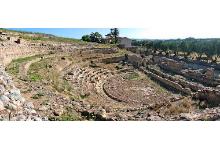
The northern part of the archaeological area is marked by the presence of the remains of a Roman settlement, identified with the colony of Croto, founded in 194 B.C.
Nearby are also located the Nao Tower, a defensive structure dating back to the sixteenth century, and the church dedicated to the Madonna of Cape Colonna.
The Museum is located at the entrance of the Archaeological Park. Inaugurated in 2006, it offers an exhibition route articulated in three sections, inside of large open space rooms.
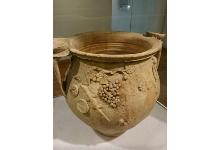
The first section is dedicated to a roman village. The showcases offer the main classes of ceramics and some objects of common use.
The second section includes the findings made in the area of the sanctuary and the reconstruction of a section of the marble roof of the temple A.
The third is a section of underwater archeology, in which are presented a series of discoveries which occurred in the sea surrounding the promontory; particularly the load of roman marbles from the Punta Scifo wreck.
Condizioni d'uso della risorsa digitale:

Quest'opera di MetsTeca è distribuita con Licenza Con attribuzione, no opere derivate, senza riuso commerciale.
View related digital collections
Is referenced by:
consulta la scheda dell'Anagrafe Luoghi della Cultura
see website
Parco archeologico
Parco archeologico
Museo e Parco archeologico nazionale di Capo Colonna
Provider
Anagrafe Luoghi della CulturaIdentifier: mus_21
Rights
License: Con attribuzione, no opere derivate, senza riuso commerciale