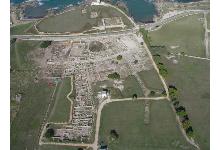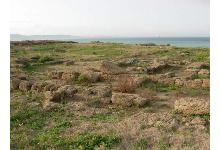

Museo e Parco archeologico nazionale di Scolacium
Type:
Luoghi della cultura; Oggetto fisico
Category:
Archaeological areas; Art museums; Archaeology museums
The Park tells the story of a city of Magna Graecia, Skylletion which became a Roman colony, Scolacium. The area, now expropriated, was part of the possessions of the families of the Mazza barons and, before that, of the Massara family from Borgia, owners of a company for the production of oil. The site is in fact immersed in a centuries-old olive grove that is the green lung of the province of Catanzaro.
The archaeological findings in the park area testify to a very ancient period, since the lower and upper Paleolithic. We do not know much about the Greek settlement, whose origins merge with the legend: it is said that it was the king of Athens Menesteo the founder of Skylletion. We know instead that the city was founded in the VI-V century BC from Greek colonists coming from Athens or from nearby Crotone in a place considered strategic along the Ionian coast, to guard the Gulf of Squillace; this, together with the Gulf of Lamezia on the Tyrrhenian Sea, is still today the narrowest point of the Italian peninsula and was occupied to ensure control over the land and river routes and promote trade relations with the entire Mediterranean basin.
The polis extended below the Roman city. The colony of Scolacium is unique in the Calabrian archaeological panorama. It was deduced in 123-122 BC. when the urban part was arranged, with the construction of the buildings typical of Roman life, and the territory was divided into cultivable parcels (centuriation). The colony prospered until the re-foundation by the emperor Nerva, when it assumed the name of Colonia Minervia Nervia Augusta Scolacium and was further monumentalized. Today it is possible to visit the Forum, with its unique brick paving that is unrivaled throughout the Roman world, overlooked by various buildings, including the Curia, the Cesareum and the Capitolium. Not far from the square there is a 3,500-seat theater, set in a Greek style, on a natural hill and the remains of the only Roman amphitheater in Calabria. The city was also equipped with baths, two aqueducts, fountains and necropolis.
The life of the colony ended when, around the VII-VIII century, the population moved first on the hill of the theater and then up to Squillace, due to phenomena of swamping that made the area inhospitable.
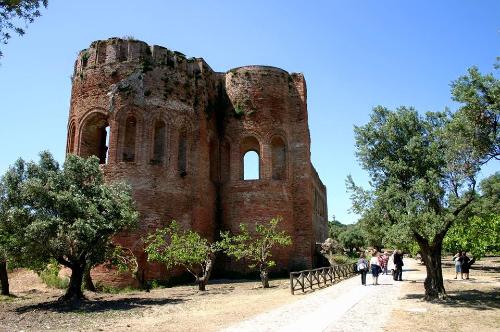
The park, however, preserves architectural remains that testify the frequentation of the site until the twelfth century: it is impossible not to notice the Norman basilica at the entrance of the tour that suggests, even in medieval times, the importance of the place, crucial point for the streets communication and for relations with the territory. Inside the park it is possible to visit the Museum where the results of the excavation campaigns are exposed. It preserves artifacts that document the ancient life in every respect. In the Museum is also preserved an important cycle of statues and Roman portraits. Finally, we note an extraordinary artifact: the colossal bronze forearm.
The archaeological findings in the park area testify to a very ancient period, since the lower and upper Paleolithic. We do not know much about the Greek settlement, whose origins merge with the legend: it is said that it was the king of Athens Menesteo the founder of Skylletion. We know instead that the city was founded in the VI-V century BC from Greek colonists coming from Athens or from nearby Crotone in a place considered strategic along the Ionian coast, to guard the Gulf of Squillace; this, together with the Gulf of Lamezia on the Tyrrhenian Sea, is still today the narrowest point of the Italian peninsula and was occupied to ensure control over the land and river routes and promote trade relations with the entire Mediterranean basin.
The polis extended below the Roman city. The colony of Scolacium is unique in the Calabrian archaeological panorama. It was deduced in 123-122 BC. when the urban part was arranged, with the construction of the buildings typical of Roman life, and the territory was divided into cultivable parcels (centuriation). The colony prospered until the re-foundation by the emperor Nerva, when it assumed the name of Colonia Minervia Nervia Augusta Scolacium and was further monumentalized. Today it is possible to visit the Forum, with its unique brick paving that is unrivaled throughout the Roman world, overlooked by various buildings, including the Curia, the Cesareum and the Capitolium. Not far from the square there is a 3,500-seat theater, set in a Greek style, on a natural hill and the remains of the only Roman amphitheater in Calabria. The city was also equipped with baths, two aqueducts, fountains and necropolis.
The life of the colony ended when, around the VII-VIII century, the population moved first on the hill of the theater and then up to Squillace, due to phenomena of swamping that made the area inhospitable.
The park, however, preserves architectural remains that testify the frequentation of the site until the twelfth century: it is impossible not to notice the Norman basilica at the entrance of the tour that suggests, even in medieval times, the importance of the place, crucial point for the streets communication and for relations with the territory. Inside the park it is possible to visit the Museum where the results of the excavation campaigns are exposed. It preserves artifacts that document the ancient life in every respect. In the Museum is also preserved an important cycle of statues and Roman portraits. Finally, we note an extraordinary artifact: the colossal bronze forearm.
Inside the park, it is also possible to visit an interesting place of industrial archeology, the Frantoio, built in 1934 by the Mazza family.
Condizioni d'uso della risorsa digitale:

Quest'opera di MetsTeca è distribuita con Licenza Con attribuzione, no opere derivate, senza riuso commerciale.
View related digital collections
Is referenced by:
consulta la scheda dell'Anagrafe Luoghi della Cultura
see website
immagine
immagine
immagine
immagine
Museo e Parco archeologico nazionale di Scolacium - Carta della qualit
Provider
Anagrafe Luoghi della CulturaIdentifier: mus_159
Rights
License: Con attribuzione, no opere derivate, senza riuso commerciale